
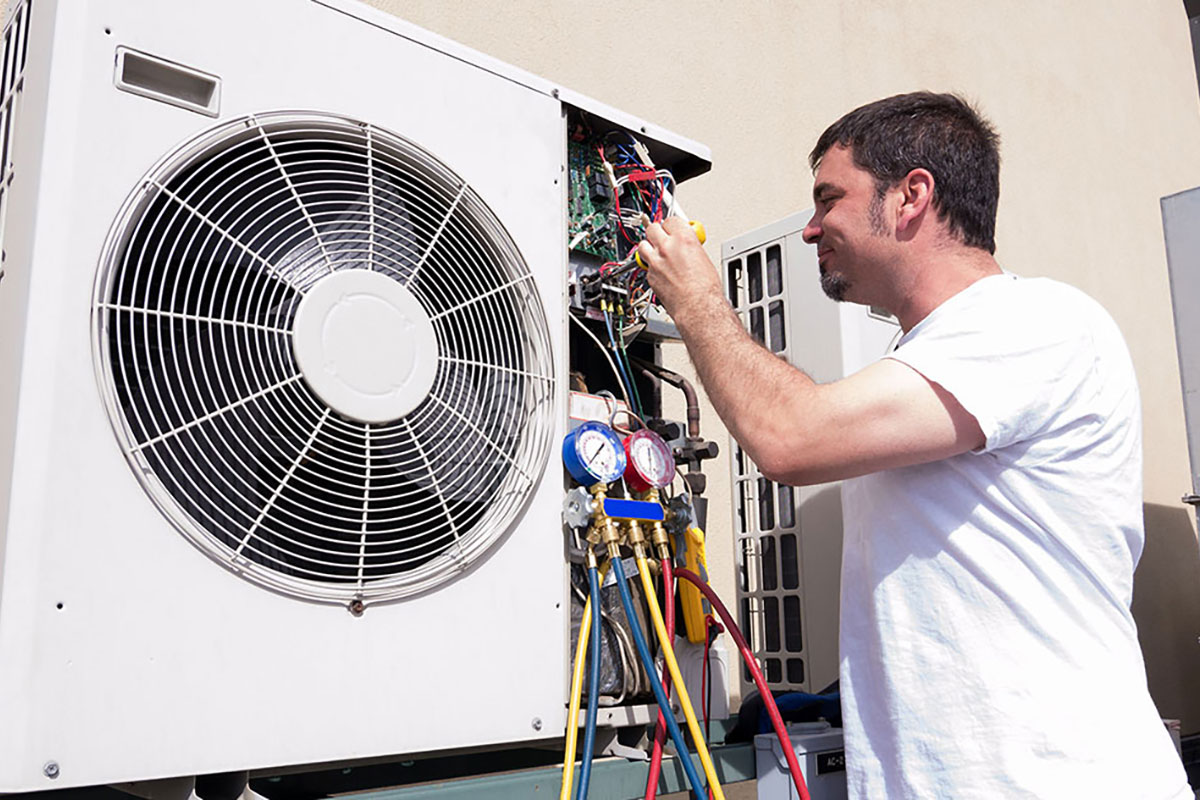
Whether to repair or replace your air conditioner comes down to four things: how old the system is, what the repair costs, how often it has been breaking down, and how much you are paying to run it. A useful rule of thumb is the 50 percent rule. If a repair runs more than about half the price of a new system and your AC is past the 10 year mark, replacing it usually makes more sense than fixing it. A newer unit with one isolated problem is almost always worth repairing.
An older system that needs a major part, leaks refrigerant, or quits on you every summer is telling you something. The right answer depends on your exact unit and your home, so the point of this guide is to help you make the call with clear eyes, instead of deciding in a panic on the hottest afternoon of the year.
Key Takeaways
- Repair usually wins when your AC is under about 10 years old and the fix is minor and isolated.
- Replace when a repair tops half the cost of a new system, breakdowns keep happening, or your bills keep climbing.
- An older R-22 system with a refrigerant leak is often a replace signal, because R-22 is scarce and expensive now.
- A new, properly sized and installed system can lower your cooling costs, but install quality matters more than the brand on the box.
- When in doubt, get a straight diagnosis and a written quote before you commit either way.
How do you decide: repair or replace?
Here is where most people are standing when they ask this question. The AC quit on the first real stretch of 90 degree days, or it is running nonstop and the house still will not cool down, and a technician has just handed you a number. Now you are doing math in your head while you sweat. Take a breath. The decision gets a lot simpler once you line up the four things that actually matter.
- Age. Most central air conditioners run about 15 to 20 years with regular maintenance. Past the 10 year mark, you are on the back half of the system’s life.
- Repair cost. A $250 capacitor is one conversation. A failed compressor or a leaking evaporator coil is a very different one.
- Breakdown history. One repair in eight years is normal wear. Two or three calls a summer is a pattern, and the pattern rarely fixes itself.
- Running cost. If your electric bill keeps creeping up while your usage stays flat, the system is getting less efficient as it ages.
Put those together with the 50 percent rule. If the repair costs more than about half the price of a new system, and the unit is already past 10 years, replacement is usually the smarter money. Say the fix is $400 on a six year old unit. Repair it without losing sleep. Say it is $2,500 on a 14 year old unit that already needed work last July. That is good money chasing a system that is on its way out.
I will tell you straight: the cheapest choice today is not always the cheapest choice over the next five years. Sinking repair after repair into an old unit often costs more than a planned replacement would have, and it usually happens at the worst possible time.
When repairing your AC makes sense
If your system is under about 10 years old, has been maintained, and the problem is a single isolated part, repair is almost always the right call. Capacitors, contactors, a fan motor, a blown fuse, a tripped float switch, a clogged drain line: these are normal, fixable problems on a unit that still has plenty of life left.
A five to eight year old AC that needs a few hundred dollars of parts is not a candidate for replacement. Fix it, and get back to your summer. The objection I hear is some version of “well, it is still kind of working.” Fair enough. A unit that cools fine and needs one repair is worth keeping. Just keep track. If you find yourself calling for the same system two or three times in a season, that is the signal to start planning, not the signal to keep patching.
When it is time to replace
Replacement moves to the front of the line when the unit is past 10 to 15 years, when a major component like the compressor or coil fails, when the repeat repairs are stacking up, or when the system simply cannot keep the house comfortable anymore. ENERGY STAR recommends that once an air conditioner passes about 10 years, it is worth considering a high-efficiency replacement, and notes a properly installed efficient unit can cut cooling costs by up to 20 percent.
New systems are rated using the SEER2 standard the U.S. Department of Energy adopted in 2023, and the colder northern region that Iowa sits in has its own minimum efficiency level. A modern unit will almost always sip less power than a 15 year old one working twice as hard to do the same job.
Think of the compressor as the engine of your air conditioner. On a unit that is already 15 years old, replacing a dead compressor is like dropping a new engine into a truck with a rusting frame. You can do it. But you are putting a strong part into a tired machine that will keep nickel and diming you, and that is usually the moment to stop repairing.
Here is the honest part, though. That “up to 20 percent” is a ceiling, not a promise. Real savings depend on the shape your old system is in, how you run it, and how well the new one gets installed. And that last point is the one people skip. A new air conditioner that is oversized, undersized, or sloppily installed will never deliver what it is rated for. A good install beats the brand on the box every time, which is why right-sizing the system with a proper load calculation, what the trade calls a Manual J, matters as much as the equipment you pick. When you replace, you are not just buying cold air for this summer. You are buying the next 15 to 20 years, so buy for that.
What the 2025 refrigerant change means for an older AC
Refrigerant is one place where an older system can tip the decision toward replacement. If your AC was made before roughly 2010, it may run on R-22, which has been phased out and is now scarce and expensive. A refrigerant leak in an R-22 system can cost more to recharge than the repair is worth, and that often pushes an old unit into replace territory on its own.
You have probably also heard that the rules changed again. Under the federal AIM Act, newly manufactured residential systems have used lower-impact A2L refrigerants like R-454B since January 1, 2025, as part of the R-410A phasedown. If your current system uses R-410A, take a breath: it is still perfectly legal to own and to service, and you do not need to rush out and replace it. Supply of R-410A will tighten and prices will rise over the coming years, but a healthy R-410A system has plenty of road left.
What if it is a lake home you only visit on weekends?
This is where the math changes, and it is the part most repair-or-replace advice skips entirely. If your place is a weekend or seasonal home on West Okoboji, East Okoboji, or Spirit Lake, nobody is there to notice the AC struggling. A unit that is low on refrigerant or short-cycling will limp along quietly, and the first you hear of it is walking in Friday night to a hot, muggy house. Worse is the humidity that sat in a closed-up cottage all week and went to work on the floors and the cabinets. For a full-time home, “still kind of working” buys you time. For a lake home, it buys you a problem you never saw coming.
Two things matter more for these places. First, a lot of the older cottages around Arnolds Park and Milford still run their original ductwork and an aging, undersized system, so when you do replace, sizing it right for the actual house matters as much as the unit you choose. Second, a connected thermostat earns its keep here, because it lets you watch the temperature from your phone and flags trouble before you make the drive up. If you would rather hand the whole thing off, that is exactly what Lake Home Service is for: opening, closing, and keeping an eye on the place while you are three hours away.
What AC repair and replacement cost
Costs vary a lot by system, but national estimates give you a sense of the ballpark. Figures compiled by Angi put most AC repairs anywhere from a little over $100 for a small part to around $2,000 for a major one, and a full system replacement commonly in the range of about $3,900 to $8,000 or more. What moves the number is system size, the efficiency tier you choose, whether any ductwork needs attention, and how involved the install is.
Those are general national numbers, not a Comfortec quote. The only way to get a real figure for your home is to have someone size the system and look at your setup, which is exactly what a request a quote visit is for. One word of caution while you compare: the lowest bid is rarely the cheapest job once you account for sizing, install quality, and what happens after the sale.
What about a heat pump or geothermal?
If you are replacing anyway, it is worth looking at what else the money could buy. A heat pump cools your home in summer and heats it in winter from the same equipment, which is why a lot of Iowa homeowners are taking a serious look at how a heat pump can pull double duty. For a longer horizon, a geothermal system is the most efficient option on the table and routinely lasts 25 years or more.
Neither is for everyone. Both cost more up front, and they pay back over years rather than overnight. Some older houses fight you on ductwork or loop space. That is the honest tradeoff, and it is the kind of thing worth talking through before you sign anything.
How Comfortec helps you decide
Comfortec Heating, Cooling & Plumbing has been working in Iowa Great Lakes homes since 2004, and we service and repair any brand while installing Carrier, Ruud, and Lennox. When your AC acts up, the job is to give you a straight diagnosis and an honest read on repair versus replace, not a scare tactic. If you do replace, we size the system properly, our technicians use carpet masks, shoe covers, and drop cloths so your home is left as clean as we found it, every new install includes first-year maintenance, and the work is backed by our Lifetime written Workmanship Guarantee. If your AC just died in the heat, you can schedule a service call and we answer the phone around the clock, because air conditioners do not quit on a 9-to-5 schedule.
Frequently Asked Questions
How long should a central air conditioner last?
Most central systems run about 15 to 20 years with regular maintenance. ENERGY STAR suggests considering a high-efficiency replacement once a unit passes about 10 years, since older systems lose efficiency and reliability as they age. How you maintain it and how hard you run it both matter.
Is it worth repairing a 15 year old air conditioner?
For a small, isolated fix, sometimes yes. For a major repair like a compressor or coil, usually no. At 15 years you are near the end of the system’s expected life, so putting big money into it often means paying twice: once for the repair, and again for the replacement a year or two later.
My AC uses R-410A. Do I have to replace it?
No. R-410A systems are legal to own and to service, and you do not need to replace a healthy one. Only newly manufactured systems are required to use the lower-impact A2L refrigerants now. R-410A supply will tighten over time, but that is a long runway, not an emergency.
Should I replace my furnace at the same time as my AC?
Often it is worth considering, especially if both are old and they share a blower and other components. A matched system tends to run more efficiently and avoids a second teardown a year later. It is a bigger expense up front, so it comes down to the age and condition of each piece, which is a good thing to walk through with a technician.
Still not sure which way to go? That is normal, and it is exactly the kind of call we make with homeowners every week. Get a straight answer and a written number before you decide: request a quote from Comfortec, or call the 24-hour line if your AC is down right now.